
Holiday Notice
We would like to inform you that our Organization will remain closed on Monday the 12th of December due to St. Spyridon celebrations.
We will resume normal operations on Tuesday the 13th of December.
For any urgent matter that might occur, you can always contact our office through the usual telephone numbers and e-mails, as our correspondence is regularly being monitored from our emergency staff.

December 8th, 2022 - PHRS Head Office
NL 278/22 | MCI - Exemption of Unmanned Non-Self-Propelled (UNSP) barges from survey and certification requirements
Refers to: Ship Owners / Managers / Operators of CI flagged vessels, PHRS Surveyors / Representatives
Action Date: 1st Nov 2022
On 1st November 2022 the amendments related to Unmanned Non-Self-Propelled (UNSP) barges that have been introduced by Resolutions MEPC 330(76) and MEPC 328(76) entered into force.
The amendments allow for UNSP barges to be exempted from certain survey and certification requirements in MARPOL Annex I, Annex IV and Annex VI, respectively.
The guidelines for the exemption of UNSP barges are detailed in MEPC.1/Circ.892, attached to this Circular.
Actions for ship owners and managers
Owners and managers of UNSP barges wishing to apply for exemptions from survey and certification requirements are required to get in touch with the certifying authority as follows:
UNSP barges with certification issued directly by Maritime Cook Islands (MCI):
• Owners/managers to get in touch with MCI;
• MCI will review the drawings as per MEPC.1/Circ.892;
• Upon satisfactory review of the drawings, an MCI-appointed surveyor will carry out the relevant survey as per MEPC.1/Circ.892;
• Based on the satisfactory result of the survey, MCI will issue the exemption certificate valid for a period not exceeding five years.
UNSP barges with certification issued by an approved RO on behalf of MCI:
• Owners/managers to get in touch with the relevant RO;
• The RO will review the necessary drawings as per MEPC.1/Circ.892;
• Upon satisfactory review of the drawings, the RO will carry out the relevant survey as per MEPC.1/Circ.892;
• Upon satisfactory results of the survey, the RO will notify MCI accordingly and MCI will issue the exemption certificate valid for a period not exceeding five years.
Maintenance of conditions
The exemption certificate ceases to be valid in case any of the approved exemption conditions (defined in MARPOL Annex I Reg.1.40, MARPOL Annex IV Reg. 1.16, and MARPOL Annex VI Reg. 2.1.32) are not met any longer after the survey.
Owners/managers are required to notify MCI in case any of the approved exemption conditions are not met, or any conversion or alteration has occurred affecting the conditions under which the exemption certificate(s) is(are) issued.
The Circular 278/2022 can be found here, in full detail.
Do not hesitate to contact us for more information you may need on the above.
November 18th, 2022 - PHRS Head Office
Refers to: Owners / Managers / Operators of Panamanian flagged vessels, PHRS Surveyors / Representatives
Action Date: Immediate
Kindly find here the latest Merchant Marine Notices and Circulars of November 2022 issued by the Panama Maritime Authority.
Website:
https://panamashipregistry.com/circulars/(Circulars)
https://panamashipregistry.com/marine-category/marine-notices/(Notices)
https://panamashipregistry.com/circulars-e-book/ (E-book)
Do not hesitate to contact us for more information you may need on the above.
December 2nd, 2022 - PHRS Head Office
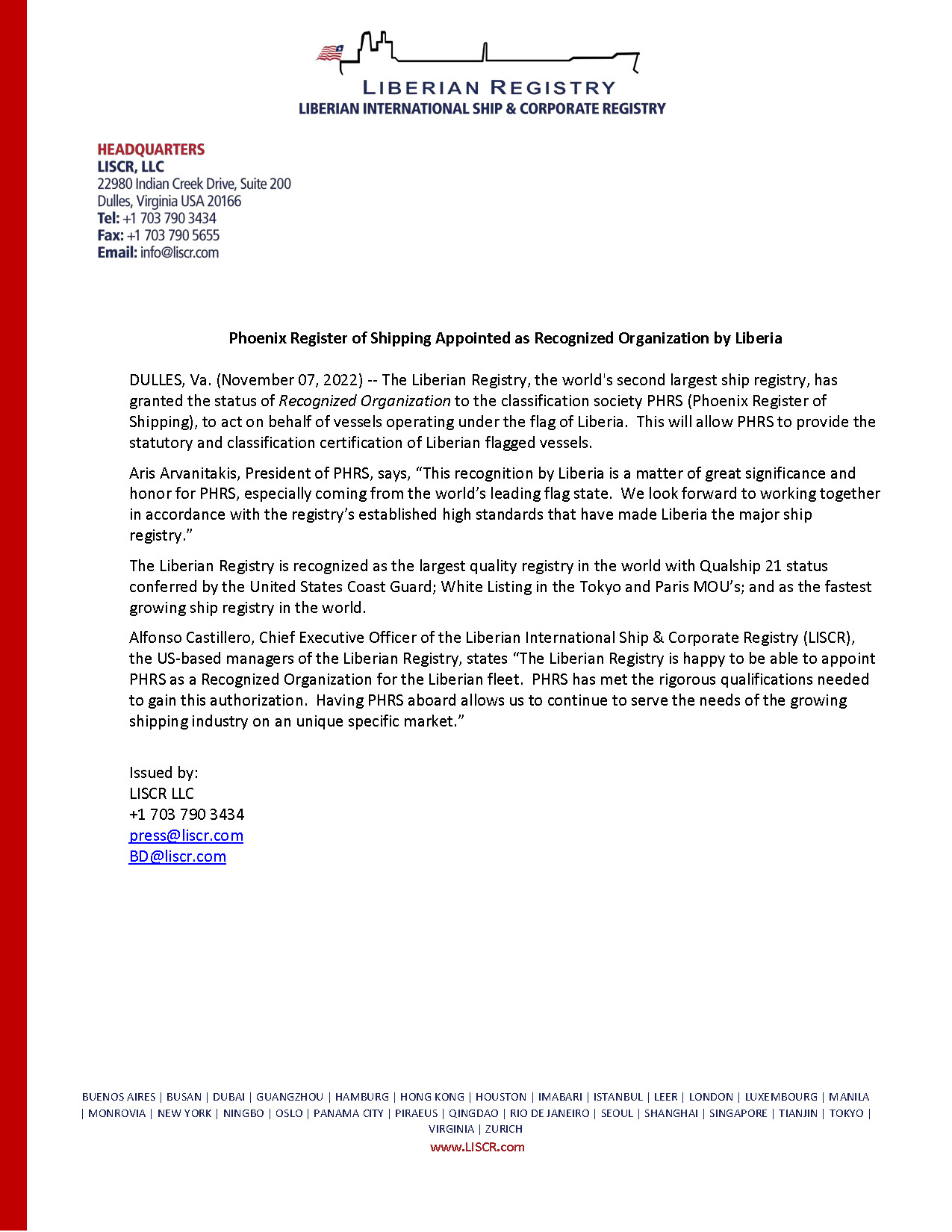
Press Release by Liberian International Ship & Corporate Registry (LISCR, LLC) about PHRS authorization.
Refers to: Ship Owners / Managers / Operators of CI flagged vessels, PHRS Surveyors / Representatives
Action Date: 1st Jan 2023
On the 1st January 2023 amendments to the Anti-Fouling Systems (AFS) Convention, adopted through Resolution MEPC.331(76) will enter into force. The amendments introduce new requirements that ban the future installation of anti-fouling systems which contain a toxic substance called cybutryne (CAS No. 28159-98-0).
Ships shall not apply or re-apply anti-fouling systems containing cybutryne on or after 1st January 2023.
Ships bearing an anti-fouling system that contains cybutryne in the external coating layer of their hulls or external parts or surfaces on the 1st January 2023 shall either:
1. Remove the anti-fouling system; or
2. Apply a coating that forms a barrier to this substance leaching from the underlying non-compliant anti-fouling system.
The measures listed above must be put in place at the next scheduled renewal of the antifouling system after 1st January 2023, but no later than 60 months following the last application to the ship of an anti-fouling system containing cybutryne.
Existing coatings on the following ships are excepted from the requirements:
1. Fixed and floating platforms, Floating Storage Units, and Floating Production Storage and Offloading installations that have been constructed prior to 1st January 2023 and that have not been in dry-dock on or after 1st January 2023;
2. Ships not engaged in international voyages; and
3. Ships of less than 400 gross tonnage engaged in international voyages, if accepted by the coastal State(s).
Actions for ship owners and managers
Owners and managers of vessels with anti-fouling systems containing cybutryne are urged to get in touch with Maritime Cook Islands at technical@maritimecookislands.com, in order to arrange for an AFS survey and the issuance of a new revised AFS certificate.
The Circular 270/2022 can be found here.
Do not hesitate to contact us for more information you may need on the above.
October 19th, 2022 - PHRS Head Office
Refers to: Owners/Managers/Operators, PhRS Surveyors/ Representatives
Action Date: Immediate
Over the last years, a great number of environmental and climate performance assessment standards have emerged for ships under the global environmental crisis. Sustainable and ecological development has become an inevitable trend in the shipping and shipbuilding industries, involving classification societies.
PhRS, focusing on clean and sustainable classification, safety, environmental protection, and increased social responsibility, has proceeded to eco-friendly adaptations, including paper-free daily operations, digital certificates, and online applications.
The highlight of this is the establishment of the Marine Environmental Sustainability (MES) Department, aiming at bringing the ships in compliance with:
• MARPOL Convention regulations, preventing and minimizing, both accidental and operational, pollution from ships.
The focus of attention constitutes the decarbonization of shipping as it is one of the most critical challenges for the maritime industry. The amendments to MARPOL Annex VI propose short-term measures to reduce carbon intensity into two categories: operational and technical.
The new measures will require all ships to calculate their Energy Efficiency Existing Ship Index (EEXI) and establish their annual operational carbon intensity indicator (CII). Ships will be required to address both areas starting in 2023 to help meet IMO’s minimum 2030 carbon intensity goal.
MES department is authorized to verify that your vessels comply with MARPOL. Our involvement ranges from plan approval to on-board surveys to maintain compliance.
• Data Collection System (DCS) on the reporting of fuel oil consumption of ships, and the EU MRV regulation (EU) 2015/757 on the monitoring, reporting, and verifying carbon dioxide emissions.
Scope of below services intend to:
- Reduce emissions from shipping, designed to gather data on CO2 emissions based on ships’ fuel consumption regarding MRV regulation.
- Collect consumption data for each type of fuel oil used and additional, specified data, including proxies for transport work, as regards DCS regulation.
Upon data submission to PhRS, the MES department carries out the necessary checks and verification procedures and issues the respective certificates to keep on-board.
• BWM Convention, regulating ballast water discharge and reducing the risk of transferring invasive aquatic species into the sea.
All ships subject to BWM Convention must implement the D-2 regulation by installing Ballast Water Treatment Systems (BWTS).
Verifying the BWM Convention's implementation and approving the relevant plans constitute another primary responsibility of the MES department.
• Hong Kong Convention (HKC) and EU Ship Recycling Regulation (EU SRR) regarding the safe and environmentally sound recycling of ships, reducing accidents, injuries, and other adverse effects on human health and the environment caused by ship recycling.
The EU Ship Recycling Regulation requires vessels to hold a valid and certified Inventory Hazardous Materials (IHM) on board.
MES department performs the necessary checks and verification procedures on the Hazardous Materials Inventory reports, and finally, a PhRS surveyor undertakes on-board verification and certification of the commitment to safe and environmentally sound practices for the vessel’s life.
For information/inquiries, feel free to reach us at mes@phrs.gr / technical@phrs.gr.
June 24th, 2022 - PHRS Head Office
Refers to: Owners/Managers/Operators, PHRS Surveyors/ Representatives
Action Date: Immediate
Introduction
In view of the need to reduce greenhouse gas (GHG) emissions from the maritime sector, MEPC. 76 adopted comprehensive short-term measures including the so-called Energy Efficiency Index for Existing Ships (EEXI) and the Carbon Intensity Index (CII). The goal is to enhance the energy efficiency of ships through the implementation of these measures.
EEXI is expected to be very similar to EEDI as it is based on the 2018 Calculation guideline of the EEDI, with some adaptations for existing vessels. EEXI describes CO2 emissions per cargo ton and per mile for existing ships of 400 gross tonnage and above. It determines normalized CO2 emissions based on installed engine power, transport capacity and vessel speed. EEXI is a design index, not an operational index. It is not related to readings from previous years and does not require onboard measurements; the index refers only to the design of the vessel.
On the other hand, CII represents an annual operational rating based on the required CII verification. MEPC 76 agreed to establish a progressive, non-linear scale of CII reductions up to 1% per year until 2023, and then between 2023 and 2027, 2% per annum, and further CII reductions, until 2030, will be decided in the review by 2026.
Depending on the proximity, a rating is recorded in the vessel's SEEMP to indicate the level of performance as A, B ,C ,D or E.
Vessels rating classification D for three consecutive years or E in one year will need to submit a corrective action plan to put forward how the objective CII would be achieved.
Note that 2030 is the year of the intermediate emissions reduction target set in the IMO’s initial strategy (IMO, 2018) to reduce CO2 emissions per transport work by at least 40% compared to 2008.
Operational carbon intensity
Attained and required annual operational carbon intensity indicator (attained annual operational CII).
After the end of calendar year 2023 and after the end of each following calendar year, each ship of 5,000 gross tonnage shall calculate the attained annual operational CII over a 12-month period from 1 January to 31 December for the preceding calendar year.
Within three months after the end of each calendar year, the ship shall report to its Administration, or any organization duly authorized by it, the attained annual operational CII via electronic communication and using a standardized format to be developed by the Organization.
The attained annual operational CII shall be documented and verified against the required annual operational CII to determine operational carbon intensity rating A, B, C, D or E, indicating a major superior, minor superior, moderate, minor inferior, or inferior performance level, either by the Administration or by any organization duly authorized by it, taking into account the guidelines developed by the Organization.
Corrective actions and incentives
A ship rated as D for three consecutive years or rated as E shall develop a plan of corrective actions to achieve the required annual operational CII.
The SEEMP shall be reviewed to include the plan of corrective actions accordingly, taking into account the guidelines to be developed by the Organization. The enhanced SEEMP (SEEMP III) shall be submitted to the Administration or any organization duly authorized by it for verification, preferably together with, but in no case later than 1 month after reporting the attained annual operational CII.
A ship rated as D for three consecutive years or rated as E shall duly undertake the planned corrective actions in accordance with the SEEMP III.
Administrations, port authorities and other stakeholders as appropriate, are encouraged to provide incentives to ships rated as A or B.
Attained energy efficiency existing ship index (EEXI)
EEXI regulation applies to existing ships of 400 gross tonnage and above. Vessels to which this regulation applies must calculate an EEXI value (i.e. attained EEXI) for each vessel and this value must be equal to or less than the maximum allowable value (i.e. required EEXI). In addition, if the achieved EEXI does not meet the required EEXI, the ship should take all countermeasures, such as: Shaft power limitation (SHaPoLi), engine power limitation (EPL), energy saving devices (ESV), etc.
The attained EEXI should be calculated in accordance with regulation 23 of MARPOL Annex VI and the 2021 Guidelines on the method of calculation of the attained Energy Efficiency Existing Ship Index (EEXI) - (resolution MEPC.333(76)) (EEXI Calculation Guidelines).
The 2013 Guidance on treatment of innovative energy efficiency technologies for calculation and verification of the attained EEDI (MEPC.1/Circ.815) should be applied for calculation of the attained EEXI, if applicable.
For verification of the attained EEXI, an application for a survey and, an EEXI Technical File containing the necessary information for the verification and other relevant background documents should be submitted to a verifier.
In cases of a major conversion of a ship taking place at or after the completion date of the survey for EEXI verification specified in regulation 5.4.7 of MARPOL Annex VI, the ship-owner should submit to a verifier an application for a general or partial survey with the EEXI Technical File duly revised, based on the conversion made and other relevant background documents. The verifier should review the revised EEXI Technical File and other documents submitted and verify the calculation process of the attained EEXI to ensure that it is technically sound and reasonable and follows regulation 23 of MARPOL Annex VI and the EEXI Calculation Guidelines. For verification of the attained EEXI after the major conversion, speed trials of the ship may be conducted, as necessary.
Ships affected by EEXI must demonstrate compliance at their next International Air Pollution Control Certificate (IAPPC) survey (annual, intermediate or renewal) or at the initial survey before the ship is put into service to obtain an International Energy Efficiency Certificate (IEEC) issued on or after January 1, 2023, whichever comes first. The effective date is November 01, 2022.
Conclusion
The shipping industry is a major contributor to global climate change, accounting for almost 3% of total CO2 emissions. This is sufficient for the implementation of IMO's rigorous criteria. The maritime industry is under a lot of pressure to reduce CO2 emissions. Numerous studies are being conducted to increase the efficiency of this industry in order to mitigate the potential risks that may arise in the future.
The environment is the biggest winner. Due to the fact that the worldwide fleet renewal rate is so sluggish, regulating the energy efficiency of new vessels through EEDI is simply too slow to have an impact on total emissions. Likewise, increasing regulatory pressure to improve the energy efficiency of new ships may reduce interest in renewing the existing global fleet. Existing and new ships are subject to the same regulations, leveling the playing field.
In 2023, the Carbon Intensity Indicator (CII) will be implemented alongside with the EEXI regulation. This indicator takes into account actual CO2 emissions from ship operations.
The IMO Marine Environmental Protection Committee (MEPC) has scheduled its 78th session from 6 to 10 June 2022, presenting an executive summary with more technical information and explanations on regulations regarding IMO GHG Strategy.
Do not hesitate to contact us for more information you may need on the above.
June 3rd, 2022 - PHRS Head Office
Holiday Notice
We would like to inform you that our Organization will remain closed on Friday the 28th of October due to Public Holiday.
We will resume normal operations on Monday the 31st of October.
For any urgent matter that might occur, you can always contact our office through the usual telephone numbers and e-mails, as our correspondence is regularly being monitored from our emergency staff.
October 26th, 2022 - PHRS Head Office
Feel free to submit your application for surveys/ certification via https://eapp.phrs.gr/Home/Login.
For more information on the above, do not hesitate to contact us at mail@phrs.gr / technical@phrs.gr .
August 25th, 2022 - PHRS Head Office
Holiday Notice
We would like to inform you that our Organization will remain closed on Monday the 15th of August due to Public Holiday.
We will resume normal operations on Tuesday the 16th of August.
For any urgent matter that might occur, you can always contact our office through the usual telephone numbers and e-mails, as our correspondence is regularly being monitored from our emergency staff.
August 11th, 2022 - PHRS Head Office