

manager
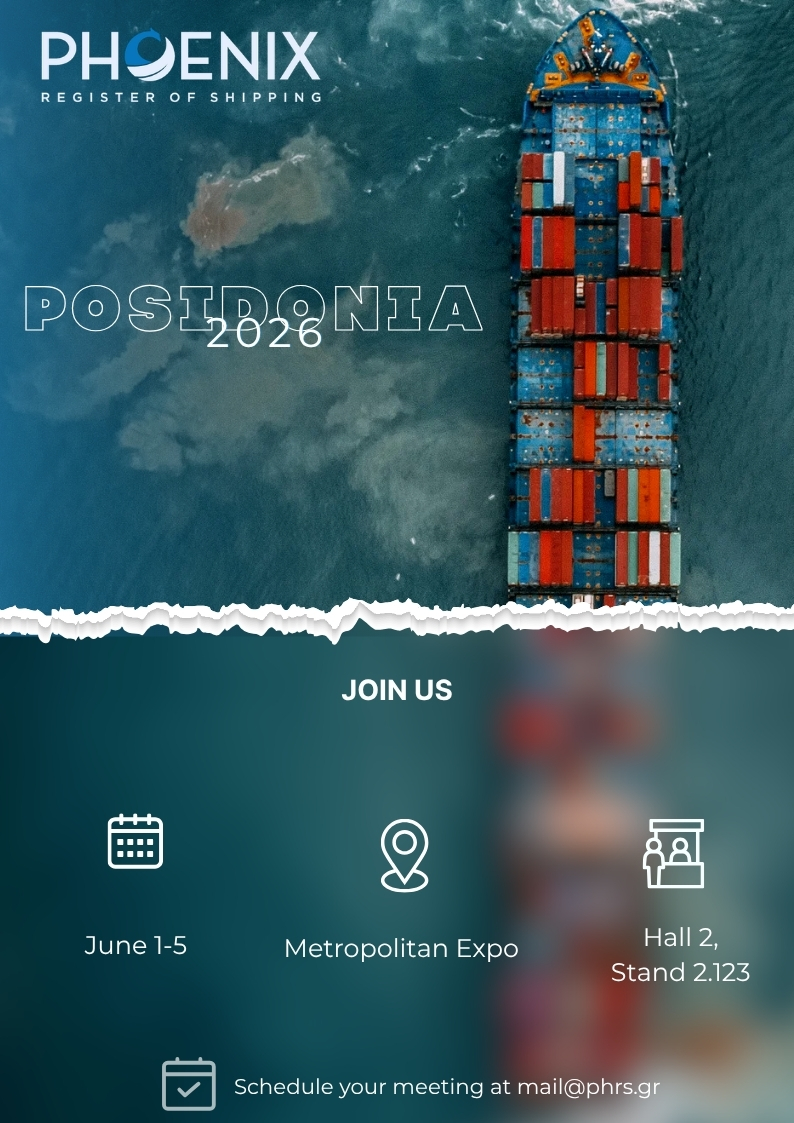
Meet us at Posidonia 2026!
May 27, 2026We are delighted to invite you to visit Phoenix Register of Shipping (PHRS) at Posidonia 2026 — the world's premier international maritime exhibition — taking place in Athens, Greece.
The organisers have secured additional parking spaces at Air Point and GuardPark private parking areas, before the airport, from Tuesday, 2/6 to Thursday, 4/6.
The parking spaces reserved for Posidonia will be clearly marked and will be serviced by continuous shuttle bus transfers provided by the organisers.
Visit the online parking slot booking platforms for Airpoint and Guard Park to pre-book your slot for each day.
Plan your Visit:
We look forward to welcoming you to our stand and to an inspiring exchange of ideas. Should you wish to schedule a dedicated meeting with our team during the exhibition, please do not hesitate to reach out at mail@phrs.gr.
We hope to see you there!
This Newsletter aims to inform all interested parties about the publication of Marine Advisory: 12/26 and Marine Advisory: 13/26 by the Liberia Maritime Authority.
1. SCOPE & PURPOSE: MARINE ADVISORY 12/26
The purpose of this Marine Advisory is to reinforce Safety Management System (SMS) requirements and operational controls related to the prevention of fatalities and serious illness associated with the consumption of alcohol, unknown or unverified liquids, and substances not intended for human consumption aboard Liberian-flagged vessels.
Recent incidents demonstrate that consumption of alcohol or unidentified substances, particularly those obtained from uncontrolled sources or involving high concentration ethyl alcohol products, can result in rapid deterioration of crew health and fatal outcomes despite onboard medical assistance.
This Advisory highlights regulatory obligations, identifies recurring safety deficiencies, summarizes recent casualty cases, and outlines required preventive actions.
For the full text please follow the link bellow.
2. SCOPE & PURPOSE: MARINE ADVISORY 13/26
The purpose of this Marine Advisory is to reinforce mandatory safety, welfare, and operational controls related to the prevention of:
• Crew suicides
• Missing persons / Man Over Board (MOB) incidents
• Unexplained personnel disappearances onboard or at sea
Recent casualty data indicates continued fatalities related to deliberate acts (suicide) and missing personnel, often involving delayed detection and inadequate crew accountability.
These incidents highlight the importance of:
• Effective crew welfare and mental health management
• Robust watchkeeping and accountability systems
• Early recognition of behavioral and psychological risk indicators
For the full text please follow the link bellow.
For any questions or further assistance, please do not hesitate to contact us at technical@phrs.gr. or Liberia’s Investigations Department at investigations@liscr.com.
1. SCOPE & PURPOSE
This Newsletter aims to inform all interested parties about the publication of Marine Advisory: 10/26 by the Liberia Maritime Authority. The Administration has identified recurring deficiencies related to Seafarer Employment Agreements (SEAs), wage payments, and financial transparency, which are core requirements under the Maritime Labour Convention (MLC, 2006, as amended).
Recent Port State Control (PSC) inspections have resulted in increased deficiencies and detentions associated with:
- Invalid or improperly executed SEAs
- Wage discrepancies and delayed payments
- Non-transparent payroll practices
This CIC aims to verify compliance with MLC Title 2 (Conditions of Employment) and ensure that seafarers’ contractual and financial rights are fully protected.
Questionnaire for the 2026 CIC on MLC Compliance – SEAs and Wages
For the full text please follow the link bellow.
For any questions or further assistance, please do not hesitate to contact us at technical@phrs.gr. or Liberia’s Fleet Prevention Department at prevention@liscr.com.
SCOPE & PURPOSE
This Newsletter aims to inform shipowners, operators, Designated Persons Ashore (DPAs), Superintendents, Masters and crew of the Australian Maritime Safety Authority (AMSA) National Compliance Plan 2025-26 about the issuance of Marine Advisory: 09/2026 by the Liberia Maritime Authority. This advisory is issued to assist Liberian-flag vessels and their operators with the preparation of the vessel to meet the AMSA compliance Plan requirements prior to arriving Australian ports. The Advisory:
- Summarizes AMSA’s compliance strategy and priority risk areas relevant to foreign‑flagged vessels trading to Australia
- Highlights inspection trends and enforcement focus that may lead to deficiencies or detention
- Assist vessel operators in preparing for Port State Control (PSC) inspections
This Advisory is intended as guidance only, to support compliance readiness and does not replace any statutory requirements.
For the full text please follow the link bellow.
For any questions or further assistance, please do not hesitate to contact us at technical@phrs.gr.
1. Purpose
This Newsletter is issued to inform PHRS Surveyors, Auditors, Head Office personnel and interested stakeholders of the main outcomes of the 84th session of the IMO Marine Environment Protection Committee, MEPC 84, held at IMO Headquarters in London from 27 April to 1 May 2026. MEPC 84 addressed several important environmental and regulatory matters, including greenhouse gas reduction measures, energy efficiency, ballast water management, air pollution prevention, marine plastic litter, underwater radiated noise, oil pollution prevention and protected sea areas.
2. IMO Net-Zero Framework and GHG Reduction Measures
MEPC 84 continued discussions on the IMO Net-Zero Framework and the development of mid-term greenhouse gas reduction measures. However, no final agreement was reached at this stage, as Member States continued to hold different views on the way forward, including whether the framework should be adopted with limited changes or further adjusted to reflect market readiness and fuel availability.
Discussions will continue through two intersessional working groups on GHG reduction before MEPC 85. MEPC 85 is tentatively scheduled for 30 November to 3 December 2026, while the resumed MEPC ES.2 is planned for 4 December 2026, subject to further discussion.
MEPC 84 also completed the terms of reference for the Fifth IMO GHG Study, which is expected to support the review of the IMO GHG Reduction Strategy in 2028.
3. Review of Short-Term GHG Measures — EEXI, CII and SEEMP
MEPC 84 continued the review of the IMO short-term GHG reduction measures, including EEXI, CII and SEEMP. The Committee adopted amendments to the EEDI calculation and survey/certification guidelines in order to better address dual-fuel ships. It was also clarified that, for the time being, the existing CII calculation methodology remains unchanged, using supply-based transport work as the basis for calculating attained annual operational CII.
Further discussions were held on strengthening SEEMP requirements, including the possible introduction of regular internal reviews, continuous improvement arrangements, clearer accountability, stronger audit arrangements and an Energy Efficiency Implementation Log. This work was not finalized and will continue at a future session.
Proposals related to a CII metric for adverse weather and a revised metric for cruise passenger ships were also discussed but were not agreed at this stage.
4. Ballast Water Management
MEPC 84 approved draft amendments to the Ballast Water Management Convention. The amendments place stronger emphasis on the actual performance, maintenance and operation of Ballast Water Management Systems, rather than only their installation and type approval.
In practice, shipowners and operators will need to demonstrate that BWMS are properly maintained, functioning effectively and achieving the D-2 discharge standard. Surveyors and Port State Control are expected to focus more closely on maintenance records, alarms, failures, corrective actions and crew familiarization.
The amendments also introduce requirements concerning updated and controlled Ballast Water Management Plans, BWMS maintenance records, reporting of failures, repair planning, and active substance controls. The amendments are expected to be adopted at MEPC 85, with an anticipated entry into force in May 2028. MEPC 84 also adopted MEPC.409(84) — 2026 Guidelines for Ballast Water Management and development of Ballast Water Management Plans (G4).
5. MARPOL Annex VI and Air Pollution Prevention
MEPC 84 adopted amendments to MARPOL Annex VI, including the designation of the North-East Atlantic as an Emission Control Area (ECA) for nitrogen oxides, sulphur oxides and particulate matter. The new ECA covers areas including Greenland, Iceland, the Faroe Islands, the western coasts of the United Kingdom and Ireland, and extends southwards towards Spain and Portugal.
For SOx requirements, ships operating in the area will be required to use fuel oil with sulphur content not exceeding 0.10% m/m from 1 September 2028. NOx Tier III requirements will apply to ships constructed according to the relevant dates specified in the adopted amendments.
Further amendments were also adopted to align MARPOL Annex VI with the NOx Technical Code regarding the use of multiple engine operational profiles for marine diesel engines.
6. IMO DCS, Fuel Consumption Data and Transparency
MEPC 84 considered developments related to the IMO Data Collection System. Amendments to MARPOL Annex VI will enhance access to fuel oil consumption data, including access by Administrations and Recognized Organizations to data for their ships, and wider access to anonymized data for analysis and transparency purposes. These amendments are expected to enter into force on 1 September 2027.
7. Methane, Nitrous Oxide and Emission Measurement Guidelines
MEPC 84 adopted new guidelines related to the measurement and monitoring of methane and nitrous oxide emissions from marine diesel engines. These include guidelines for test-bed and onboard measurements, engine load monitoring and continuous emission monitoring systems. The guidelines are intended to support more accurate and verifiable assessment of tank-to-wake emissions, particularly in the context of alternative fuels and future GHG frameworks.
8. Marine Plastic Litter from Ships
MEPC 84 adopted the 2026 Strategy and Action Plan to Address Marine Plastic Litter from Ships. The Committee also agreed that further work should continue on the development of a mandatory code for the maritime transport of plastic pellets in freight containers, together with possible amendments to MARPOL Annex III and/or SOLAS. Further work will also continue on fishing gear marking systems, voluntary reporting of lost or discharged fishing gear, and data collection on waste generated by ships during normal operations.
9. Underwater Radiated Noise
MEPC 84 continued its work on underwater radiated noise from ships, recognizing the potential impact of commercial shipping noise on marine life, particularly marine mammals. The Committee agreed in principle to extend the experience-building phase for the reduction of underwater radiated noise until 2028. It also approved MEPC.1/Circ.924, providing technical guidance on co-optimizing energy efficiency and underwater radiated noise at the design and retrofit stage.
10. Oil Pollution Prevention and Protected Areas
MEPC 84 approved the development of a new MARPOL Annex I regulation permitting the use of integrated bilge water treatment systems, together with supporting guidance. The Committee also agreed to the new Nasca Ridge, Peru, Particularly Sensitive Sea Area associated protective measure, and considered further proposals relating to an Arabian Sea PSSA and a Nasca Ridge MARPOL Special Area.
11. PHRS Follow-Up
PHRS will continue to monitor the outcome of MEPC 84 and any subsequent developments at MEPC 85 and related IMO working groups. The adopted and approved amendments, guidelines and future work items will be reviewed to identify any impact on PHRS Rules, procedures, survey instructions, checklists, forms, certification activities and training material.
Further guidance will be issued, as necessary, following publication of the relevant IMO resolutions, circulars and implementation instructions.
1. PURPOSE
This Newsletter aims to inform all interested parties about the issuance of Merchant Marine Circular MMC-193 by the Panama Maritime Authority. This MMC is informing all interested parties that this Administration has established through Resolution No.106-52-DGMM of September 9, 2024, the regulatory scheme for the approval of the voluntary use of Electronic Record Books on board Panamanian vessels, assuring in this way, that the international standards of maritime safety and pollution prevention contained within the International Conventions ratified by the Republic of Panama are complied with. Additionally, to inform those electronic books or electronic record books to be used as an alternative method to a hard copy record books mandatory because of the different annexes of the MARPOL Convention 73/78 as amended, shall comply with the technical specification detailed in the IMO Resolution MEPC.312(74) and with the IMO Resolution MEPC.372(80) related to electronic record books for the Ballast Water Management Convention.
2. SCOPE
this service on board Panamanian vessels.
The required services within the optional and voluntary Electronic Record Books are limited to supply any Panamanian vessel, with the electronic means for the reception, record, and control of the information about:
- MARPOL Record Book
- Crew Roll Book
- Bridge Logbook
- Ballast Water Record Book
- Any other record book the Administration determines to be necessary for the operation of the ship per the international Conventions and Codes.
For the full text please follow the link bellow.
For any questions or further assistance, please do not hesitate to contact us at technical@phrs.gr or Panama’s General Directorate of Merchant Marine at ebookspanama@segumar.com segumar.headoffice@segumar.com .
1. SCOPE & PURPOSE
This Newsletter aims to inform all interested parties about the issuance of Merchant Marine Circular MMC-408 by the Panama Maritime Authority. This MMC clarifies the provisions that are to the satisfaction of the Administration stipulated in Regulation 3-13 – “Lifting appliances and anchor handling winches.” As well as to ensure that lifting appliances and anchor handling winches fitted on Panamanian-flagged ships are designed, constructed, installed, operated, and maintained in accordance with the required standards.
2. BACKGROUND
Casualty and incident reports indicate that mechanical failures of lifting appliances have caused several accidents, resulting in property loss and, most importantly, human life lost on board. For this reason, member states and industry worked together to develop mandatory requirements for lifting appliances to reduce the number of casualties caused by substandard lifting appliances.
Finally, during the 107th Session of the Maritime Safety Committee (MSC) held from May 1 to June 9, 2023, the IMO adopted new mandatory requirements for lifting appliances and anchor handling winches, which were embedded into the International Convention for the Safety of Life at Sea (SOLAS) by the Resolution MSC.532(107). Moreover, Amendment MSC.532(107) includes the addition of regulation 13-13 – “Lifting appliances and anchor handling winches in Chapter II-1, which will entered into force on January 01, 2026.
For the full text please follow the link bellow.
For any questions or further assistance, please do not hesitate to contact us at technical@phrs.gr or Panama’s Recognized Organizations Oversight Department at segumar.headoffice@segumar.com / ro-monitoring@segumar.com.
NL 394/26 | LISCR - Hazards of Fumigation using Phosphide onboard Dry Bulk Cargo Vessels
May 13, 2026
Supersedes Marine Advisory: 19/2022.
1. SCOPE & PURPOSE
This Newsletter aims to inform all interested parties about the issuance of Marine Advisory: 19/2022/Rev.1 by the Liberia Maritime Authority. This Marine Advisory provides information about the hazards associated with in-transit fumigation of cargo using Phosphides.
2. BACKGROUND
Fumigation is the process of releasing toxic gases (pesticides) into a cargo hold or compartment for the purpose of eliminating or avoiding infestation by insects or other pests that may cause the cargo to deteriorate. Fumigation may take place either prior to and/or after loading the cargo. In-transit fumigation is preferred by shippers and charterers because it reduces time in port. In recent years there has been a significant increase in the number of marine casualty incidents related to in-transit fumigation. In this regard, the Administration has recently investigated two incidents, one of which resulted in a fatality:
- In the first incident, a crew member was fatally injured after attempting to open a hatch entrance cover during the topping up process of the Phosphide tablets. The excessive pressure from the Phosphine gas caused the hatch cover to break loose from the hinged joint and strike the crewmember.
- In the second incident, smoke was seen emanating from the cargo hold. In both incidents, crew members were required to assist the fumigation technician including the removal of the fumigation sleeves from the cargo holds.
For the full text please follow the link bellow.
For any questions or further assistance, please do not hesitate to contact us at technical@phrs.gr or LISCR’s Investigations Department at investigations@liscr.com.
1. SCOPE & PURPOSE
This Newsletter aims to inform all interested parties about the issuance of Merchant Marine Circular MMC-404 by the Panama Maritime Authority. This MMC provide information on the measures implemented to enhance the performance of the Panamanian Merchant Marine Fleet.
Considering that more than a year has passed since the implementation of measures to strengthen the performance of the Panamanian Merchant Marine Fleet, this General Directorate deems it appropriate to make adjustments that allow for monitoring in line with international guidelines and conventions, and international maritime jurisdiction, with a view to obtaining the best performance from Panamanian-registered vessels before the Competent Authorities in charge of supervision by the Port State Control.
For the full text please follow the link bellow.
For any questions or further assistance, please do not hesitate to contact us at technical@phrs.gr or Panama’s Navigation and Maritime Safety Department at prearrival@amp.gob.pa
Refers to: Ship-owners, Operators, Masters and Managers of PHRS certified vessels
Action Date: Immediate
1. SCOPE & PURPOSE
This Newsletter aims to inform all ship-owners, operators and Masters of vessels about the Top 20 detainable deficiencies identified by the Liberian Registry for April 2026, based on recent Port State Control (PSC) statistics, and to enhance awareness on common root causes, preventive measures, and survey focus areas.
The most frequently identified detainable deficiencies (with codes) include:
- Auxiliary engine – 13102
- Propulsion main engine – 13101
- Maintenance of the ship and equipment – 15109
- Lifeboats – 11101
- Gauges, thermometers etc. – 13103
- Fire-dampers – 7115
- Nautical publications – 10116
- ISM – 15150
- Fire fighting equipment and appliances – 7110
- Fire doors/openings in fire-resisting divisions – 7105
- Ventilators, air pipes , casing – 3108
- Emergency source of power - Emergency generator – 4114
- Emergency lighting, batteries and switches – 4103
- Oil accumulation in engine room – 7126
- Rescue boats – 11104
- Fire pumps and its pipes – 7113
- Fixed fire extinguishing installation – 7109
- Magnetic compass – 10105
- Fire Detection and Alarm System – 7106
- Steering gear – 2105
- Navigation Lights ( Masthead, Sternlight, Anchor,etc) – 10105
2. COMMON ROOT CAUSES OF PSC DETENTIONS
PSC inspections indicate that detainable deficiencies often arise from:
- Inadequate maintenance or testing
- Lack of effective onboard verification prior to arrival at port;
- Insufficient crew familiarization and training, particularly for emergency duties;
- Incomplete, inaccurate, or outdated documentation and records.
3. RECOMMENDATIONS TO SHIP-OWNERS AND OPERATORS
To reduce the risk of PSC detention, ship-owners and operators should be strongly encouraged to:
- Conduct pre-arrival internal checks, focusing on:
- Fire safety systems
- Life-Saving Appliances (LSA)
- ISM implementation
- Pollution prevention equipment
- Ensure all safety and emergency equipment is operational, tested, and readily available;
- Verify that crew are familiar with emergency duties and ship-specific procedures;
- Review and update statutory certificates, logs, and records prior to port entry;
- Pay particular attention to recurring PSC deficiency areas highlighted in this Circular and in PHRS PSC bulletins.
As a recognized organization, PHRS will continue to:
- Monitor PSC trends affecting ships classed and/or certified by PHRS;
- Share relevant information for awareness and preventive purposes through Technical Circulars, Newsletters, and PSC Bulletins;
- Support ship-owners and operators through technical guidance, clarification, and proactive engagement.
For any questions or further assistance, please do not hesitate to contact us at technical@phrs.gr